Urban bees response to backyard gardens
- Institution
- University of British Columbia Okanagan
- Collaborators
- M. Repovs, Dr. Jason Pither
- Study system
- Native bee genera in urban gardens
- Methods
- Garden bee surveys along an urbanisation gradient
- Location
- Kelowna, British Columbia
- Status
- In press
Urbanization has led to significant habitat loss, posing challenges
for native bee populations. In response, initiatives like “Border
Free Bees” in Kelowna, British Columbia, have encouraged landowners
to create pollinator-friendly gardens, providing forage and nesting
resources to support urban bee diversity. But how effective are
these gardens in sustaining native bee populations, and how does
urbanization influence their impact?
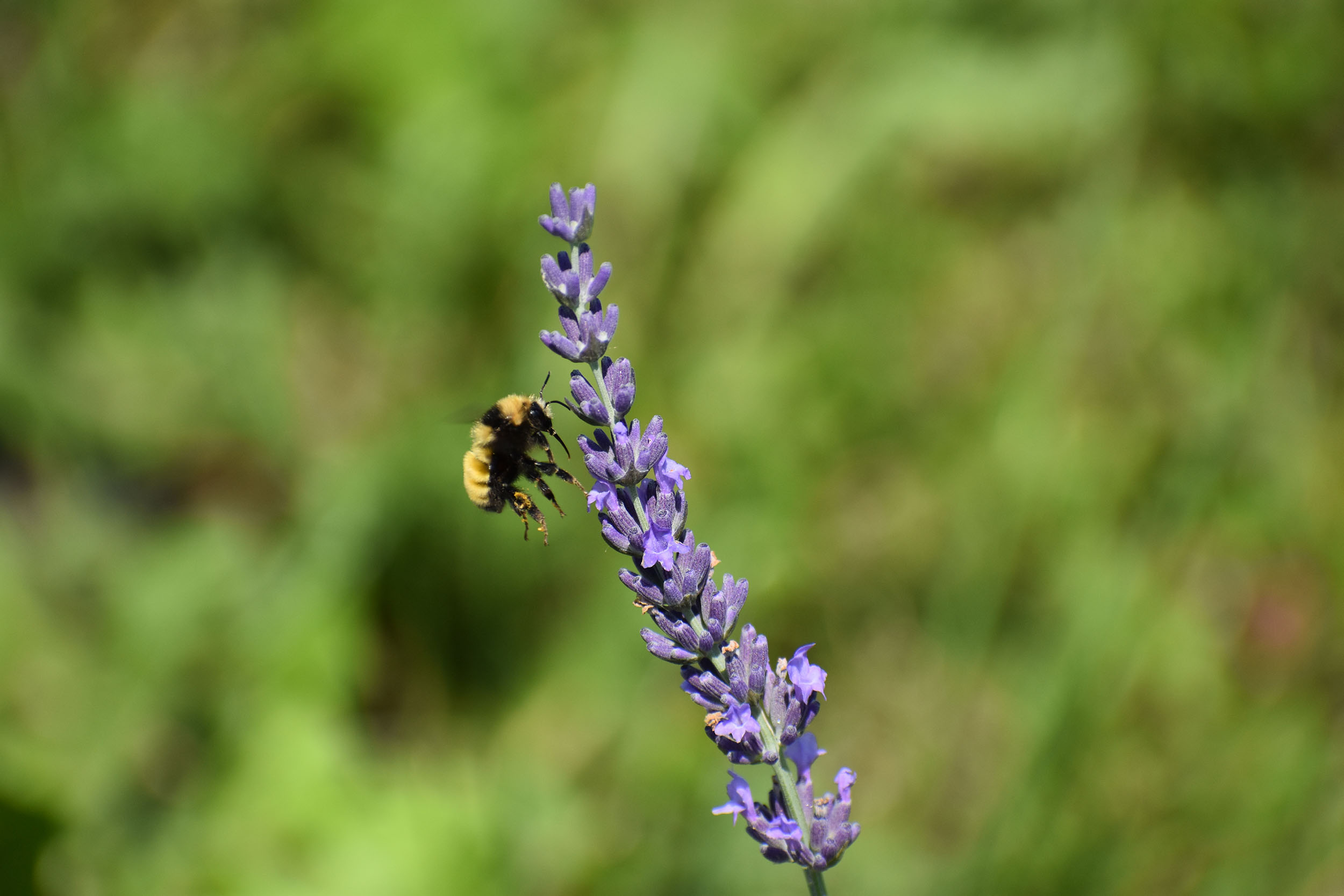
Surprisingly, we didn’t find a clear link between the number or
variety of bees and things like garden size, plant diversity, or how
urbanized the surrounding area was. This suggests that while
pollinator gardens are important, other factors, like access to
nesting areas or nearby wild habitats, may play a bigger role in
supporting bee populations.
This is the first study to look at urban bee diversity in the
Okanagan, a region known for its rich pollinator communities. While
planting pollinator-friendly gardens is a great step, our findings
highlight the need to think beyond individual gardens and consider
how we can create connected, bee-friendly landscapes. Supporting
bees in cities takes a big-picture approach, and every garden is a
valuable piece of the puzzle.
Research significance
Pollinator-garden programmes are among the most widely adopted urban biodiversity interventions and among the least evaluated. Finding no clear relationship between bee richness or abundance and garden size, floral diversity, or surrounding urbanisation is an informative negative result: it shifts attention from garden composition towards nesting resources and landscape context. It is also the first characterisation of urban bee diversity in the Okanagan.
Outputs
- Repovs M, Liczner AR, Pither J. 2025. Native bee genus diversity within bee-friendly urban gardens varies little along an urbanization gradient. EcoEvoRxiv. In press.